
Sa Đéc Market: Where the Rivers Once Met
(fme.travel)Some markets exist to buy and sell. But some markets keep the way a land has lived, met and grown over many generations. Sa Đéc Market is one such place. Once a bustling trading centre of the six provinces of Cochinchina, this market beside the Tien River did not only exchange goods, but also connected the streams of people, boats and cultures that travelled up and down the Mekong for hundreds of years.

A meeting point of the six provinces of Cochinchina
There was once a time when Sa Đéc was known not only for what it produced, but for what it gathered. In 1832, when King Minh Mạng divided Cochinchina into six provinces, Sa Đéc belonged to Tân Thành prefecture, An Giang province - part of the land collectively called the six provinces of Cochinchina (Lục Tỉnh Nam Kỳ), where the town stood at one of the most important trading crossroads, the rivers connecting distant lands and goods moving ceaselessly to and fro.
Even earlier, in 1820, when presenting to King Minh Mạng the geographical work 'Gia Định Thành Thông Chí,' the mandarin Trịnh Hoài Đức recorded of this place: 'Sa Đéc Market lies to the east of the administrative seat; Vĩnh An Market sits on the riverbank, with shops in continuous rows like fish scales, stretching five miles.' Those few short lines alone reveal the scale and bustle of this riverside market more than two centuries ago.
Sa Đéc Market became one of those important gathering points, where farm produce, household goods and daily necessities poured in from across the Mekong Delta, then spread out from here to the smaller markets in the region.
The market was not separate from the river. It was an extension of the river itself, where boats came to dock, exchanged goods, then continued on their journey.

How old is the market
'When did this market start, and how old is it…' is a question not a few visitors have asked when first stepping in, standing amid the rows of stalls packed side by side from the earliest hours of the morning.

'This is Sa Đéc Market, ma'am - this is Sa Đéc's farm-produce market,' a guide explained. 'This is the wholesale market that ships goods to the smaller markets; there's a fish market, a vegetable market, and a farm-produce market further down as well.'
The answer to the market's age lies in its very rhythm: a wholesale market shipping goods everywhere, with separate fish, vegetable and farm-produce sections, all running smoothly as they have for generations. Today, the market still holds that role, though the pace and form have changed somewhat over time.
One architectural mark remaining from the early period is the market hall (nhà lồng chợ), built at the end of the 19th century with an Eiffel-style steel column frame - an architectural style characteristic of Southern Vietnamese markets of the day, where Vietnamese life and Western building techniques crossed right on the riverside market. Through many upheavals, the Sa Đéc market hall was later rebuilt, but still tried to echo the old lines, keeping part of the memory imprinted in many generations of local people.
A day at the market
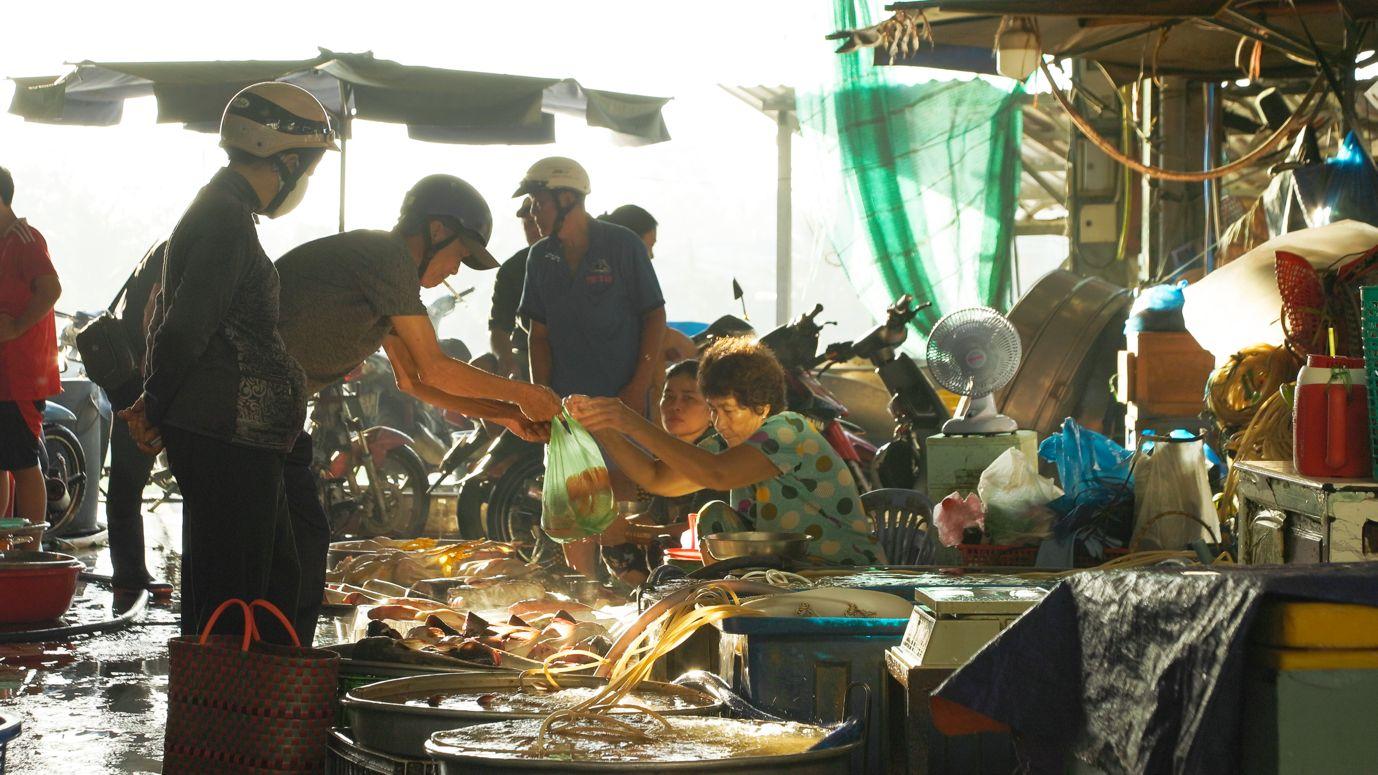
Stepping into the market, the first impression is always the ceaseless movement. The stalls follow one after another, brimming with fresh farm produce, prepared food and everyday items. Buyers and sellers pause, choose, chat, then resume their own pace.
'Here we have a whole row selling votive paper goods, ma'am - let me take you there,' a trader enthusiastically offered, 'the offerings are gathered here, with many designs and many kinds of goods.' Amid these rows are the breakfast stalls, where hủ tiếu and familiar dishes are sold right on the spot, steam rising thick each early morning.
There is no fixed path through the market. The space opens up through countless small interactions, repeated steadily all day, creating a rhythm at once bustling and familiar.
Familiar faces
Many traders have been bound to the market for years, sometimes across several generations of the same family. A stall passed from mother to child, a habit repeated year after year - all create a depth not easily seen at first glance, but felt over time spent here.
For those bound to it for many years, the market is not only a place of trade. 'I miss it so much - I miss the people here,' someone who once worked at the market shared, 'when we meet, we can talk all day.' It is a place that keeps its people, its conversations that can stretch a whole day without running out of things to say.

Two hundred years, one rhythm of market days
Interestingly, when placed side by side, Trịnh Hoài Đức's 1820 record and the scene of Sa Đéc Market today are not so different: still shops packed along the riverbank, still the ceaseless rhythm of trade from early morning. The biggest change, perhaps, is how people move: boats are no longer the only means, but the river is still there, still quietly nourishing the market's rhythm as it has for the past two centuries.
It is this continuity, rather than any grand structure, that makes Sa Đéc Market a destination worth slowing down to observe: a place where past and present do not oppose each other, but simply interweave in every market gathering.

Experience Sa Đéc Market with FME Travel
FME Travel suggests visiting Sa Đéc Market very early, when the market has just come alive and the atmosphere is at its most intact. Stroll through each row of stalls, stop to chat with traders bound to the market for years, and don't hesitate to try a hot bowl of hủ tiếu right at the breakfast area in the market.
This is also a good chance to buy the region's characteristic products, from fresh farm produce to small souvenirs. A local guide will help you understand more of the story behind each corner of the market you pass.
Sa Đéc Market: when a market keeps the spirit of a whole land
Sa Đéc Market is more than a place to buy and sell. It reflects how a community organises itself, connects with its surrounding environment, and sustains the rhythms of exchange that have existed across generations of traders.
It is a way to understand Sa Đéc through everyday life - not through show, but through careful observation. At the same time, it supports a form of travel that values depth over surface, where visitors are invited to move, observe and take part at their own pace.
An invitation from Sa Đéc
The market does not try to stand out. It simply continues, as it always has for decades. And in that continuity, it keeps intact the very spirit of this land.