
The Sa Đéc Flower Village: Where the Gardens Tell Stories
(fme.travel)There are gardens made only for looking at. But there are also gardens where behind every tree lies the memory of many lifetimes. The Sa Đéc flower village is one such place. With more than a hundred years of history along the Tien River, it is not only one of the largest flower-growing regions in the Mekong Delta, but also a land where people quietly tell the story of their lives through each blooming season.

A craft village that grew up with the water
The Sa Đéc flower village formed in the early years of the 20th century, first known as the Tân Quy Đông flower village. From the small gardens of a few families, the village grew over generations to become, today, the largest flower and ornamental-plant capital in the Mekong - with a cultivated area of about 950 hectares, more than 4,000 producing households (nearly half of the region's farming households), along with more than 190 trading establishments, 13 enterprises and 2 flower-and-ornamental-plant cooperatives. In 2025, the "Sa Dec flower and ornamental plant growing craft" was officially recognized as a National Intangible Cultural Heritage.
What sets this place apart from any other flower village lies in the way people converse with the very water around them. Many flowers here are grown on raised racks, right above the water surface. Wooden frames lift each row of plants above the canal, forming narrow paths in between, so that walking through them feels like moving among flowing streams of colour. Today, the flower village holds more than 2,000 species of flowers and ornamental plants, divided into three main groups: landscape and interior-decoration plants (about 65%), ancient plants and bonsai (15%), and flowers (20%).
This is not a stop for snapping a few quick photos and leaving. Every year-end, the flower village bustles in preparation for the Sa Đéc Flower and Ornamental Plant Festival, an event gathering a large-scale series of cultural, artistic and tourism activities for the whole of Đồng Tháp province. But outside the festival season, the flower village remains a space inviting you to slow down, to see how each flower bed is tended, how each season brings a different shade to the same garden.
Walking among the flower paths
Three names are tied to the journey of exploring the flower village: the Sa Đéc Bonsai Museum, the Tư Tôn Rose Garden and the Ngọc Lan Flowers & Ornamentals. Each has its own distinct character, but together they weave the shared picture of the whole craft village.

Some places focus on elaborately shaped bonsai art, where time shows clearly in every curve of a branch that has been tended for many years. Others are awash with the colours of flower rows in full bloom, stretching to the edge of sight, greeting the early sun.
Strolling along these paths, you will realise this is not a place to rush. Each step invites you to pause a little longer, to notice how a tree is placed just right, how a flower rack is tied, how the morning light falls on each dew-laden petal.
A calling, not a chance encounter
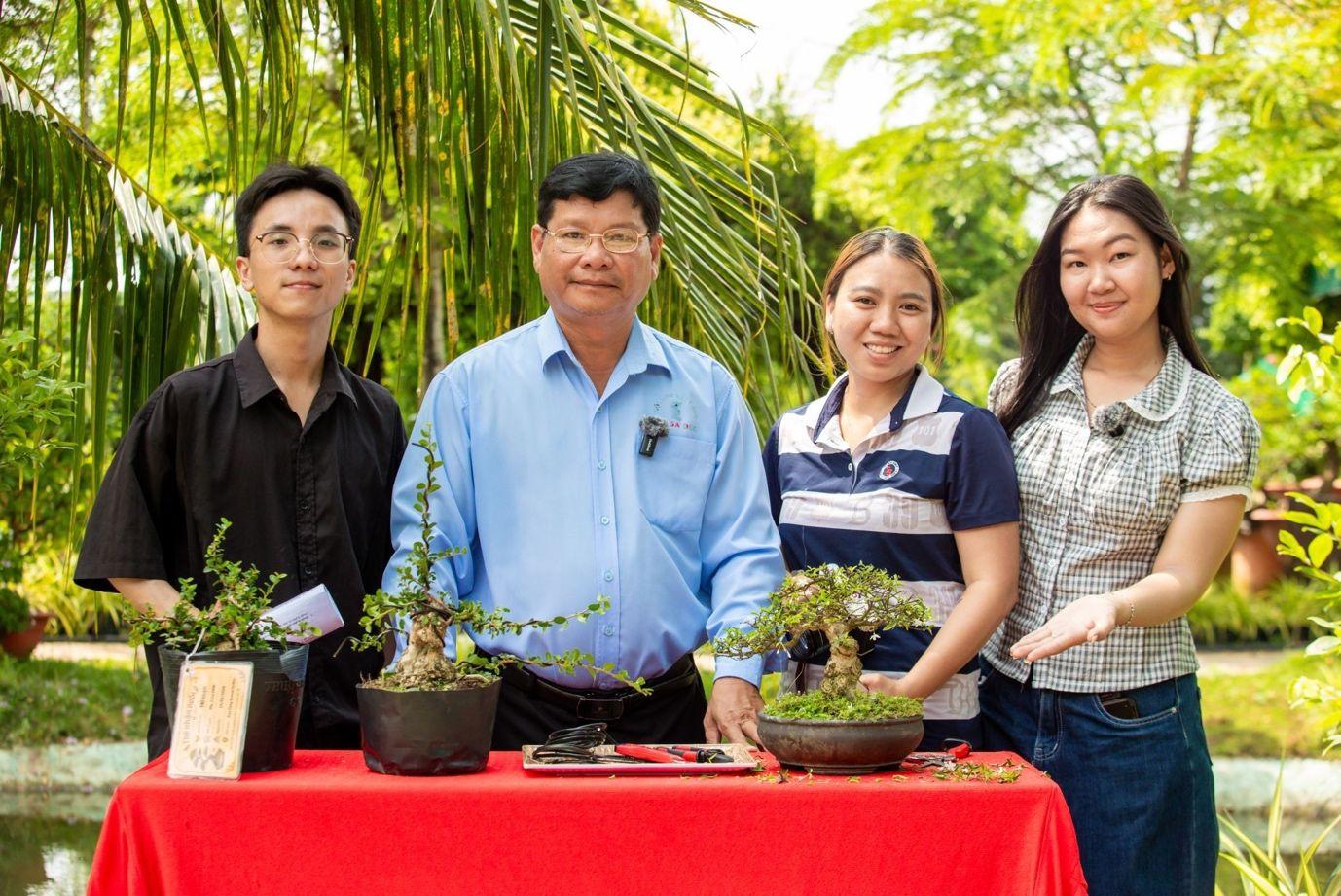
Located at 156, provincial road ĐT848, Khánh Nhơn hamlet, the Sa Đéc Bonsai Museum was built by the artisan Nguyễn Phước Lộc and now displays more than 1,000 works - regarded as the first and largest bonsai museum in the Mekong. It serves two parallel functions: preserving the value of local bonsai and passing the craft on to future generations. This art arrived in Vietnam in the late 1980s and early 1990s, and since then has taken deep root in the Sa Đéc flower village.

Uncle Lộc, the affectionate name everyone uses for the artisan Nguyễn Phước Lộc, calls his work by a very different word: a calling (nghiệp). 'This craft, to me, is a calling, not a chance encounter,' he shared, his eyes never leaving the branch he was pruning.
A bonsai work, in his words, cannot be created in a day or two. It is a process lasting five years, ten years, sometimes several decades before it is fully complete. Among the thousands of works that have passed through his hands, he is especially fond of a pair of ancient tamarind bonsai considered the oldest in Vietnam - because the value of a bonsai work, in the end, lies in its very age.
The flower season, the Tết season
Life in the flower village runs to a rhythm of its own, decided not by a work schedule but by the growing seasons. Each stage of the year carries a different shade, from sowing and waiting to the moment everything bursts fully into bloom.
As the Lunar New Year draws near, the whole flower village seems to hold its breath, waiting for the most important moment of the year. This is when the temperature is mild and the flowers freshest and most abundant, and also when the trucks carrying flowers from Sa Đéc spread out to every province, bringing the Mekong's spring to many Vietnamese homes.
These seasonal cycles shape not only the landscape of the flower village, but also the rhythm of life of those who devote their lives to the craft. Each visit brings a different image of the flower village - no two the same.
Experience the Sa Đéc flower village with FME Travel
FME Travel suggests exploring the flower village by bicycle, weaving through the small lanes among the flower racks, stopping at the Bonsai Museum to talk with the artisans, then visiting the Tư Tôn Rose Garden to hear the story of the origin of the whole craft village.
The best time to visit is early morning, when dew still rests on the petals and the sun is not yet harsh, or in the weeks approaching Tết, when the whole flower village lights up in the busiest atmosphere of the year. Take time to talk with the flower growers you meet along the way; their stories often linger longer than any photograph.
The Sa Đéc flower village: when a garden holds a whole memory
The Sa Đéc flower village is not only a place to visit. It is a place to understand how a community builds something lasting, through knowledge and care shared across generations, from grandparents to grandchildren.
The gardens here do not only display beauty. They keep memory, effort and quiet devotion - things that go far beyond what the eye can see in a single visit.
An invitation from Sa Đéc
From flower racks floating on the water to hands shaping each bonsai branch, the Sa Đéc flower village is a garden that never stands still. Come slowly enough to hear the story of each tree.

 ✕
✕